

- Artist
-
Alexander Calder
- Date
-
1936
- Medium
-
Painted steal plate and wire
- Dimensions
-
230.0×86.5×62.0cm
- Accession Number
-
RM-040
-
©︎2026 Calder Foundation, New York / ARS, NY / JASPAR, Tokyo E6362
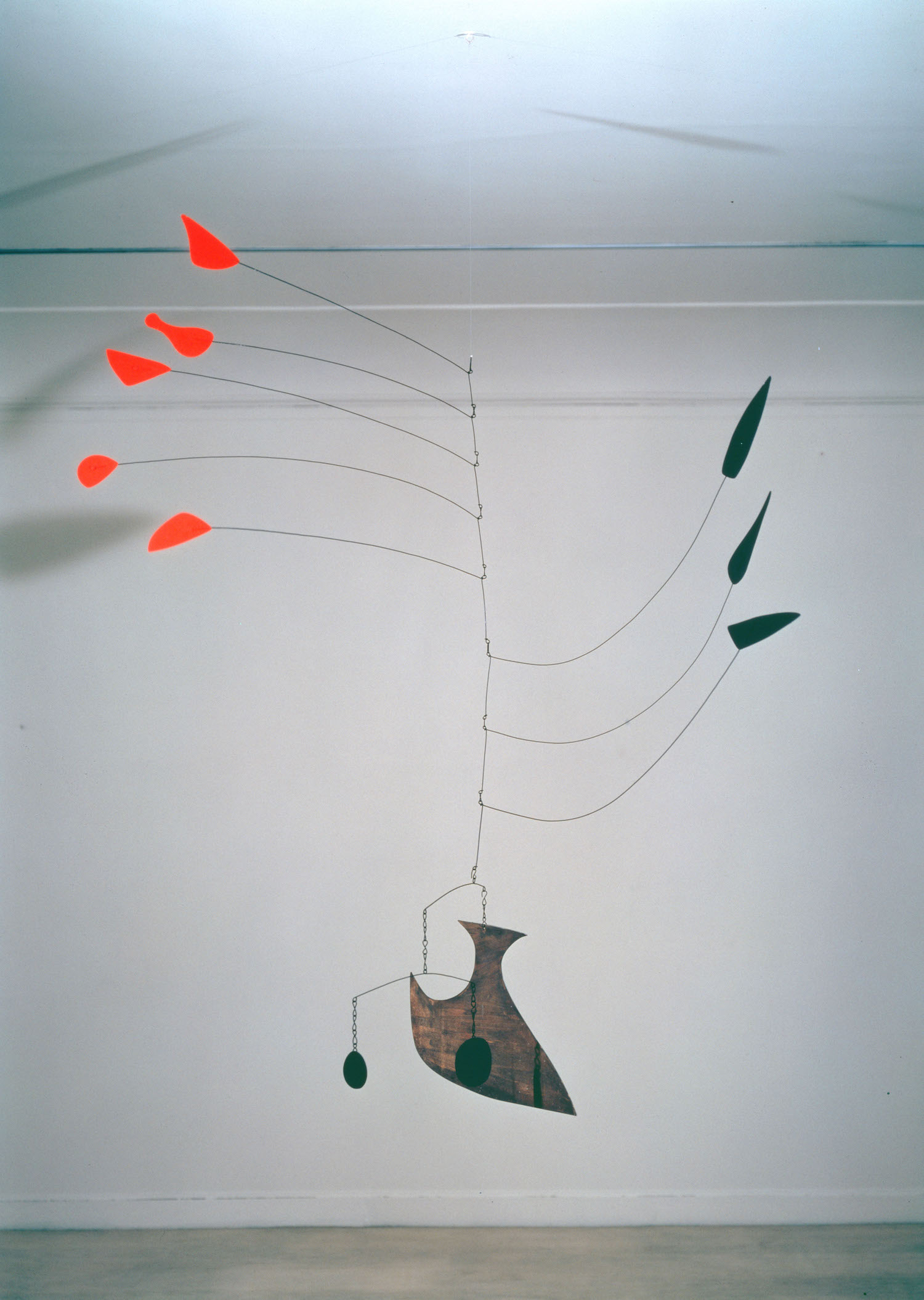
The term mobile, for which Calder became best known, was coined by Marcel Duchamp in 1931. In French, the word carries the dual meaning of both “motion” and “motive.” Some of Calder’s early mobiles were mechanically powered by motors, but he later developed motorless works that responded to air currents, light, humidity, and human interaction. He also preferred joining elements with rivets and bolts rather than welding.
Many of the early mobiles were made from carved pieces of wood left in their natural state or painted in earthy tones. Later, Calder increasingly worked with metal, restricting his palette to the primary colors of red, yellow, and blue, along with black and white. These colors were applied by hand with a brush rather than sprayed.
Calder’s innovation lay in creating sculptures that were light, dynamic, and constantly changing, in contrast to the solid and static image traditionally associated with modern sculpture. Because he was trained as an engineer, one might assume that the trajectories of his mobiles were mathematically calculated. In reality, however, they were created in a highly intuitive manner. Calder would begin by cutting out irregularly shaped discs and then experiment with different arrangements, combining and recombining the elements through a process of trial and error. He continued to refine the work until it produced the movement he intended and achieved a visually satisfying composition.
Alexander Calder
- Artist
-
Alexander Calder
- Date
-
1936
- Medium
-
Painted steal plate and wire
- Dimensions
-
230.0×86.5×62.0cm
- Accession Number
-
RM-040
-
©︎2026 Calder Foundation, New York / ARS, NY / JASPAR, Tokyo E6362