






The Museum of Modern Art, Seibu Takanawa(Karuizawa) Opening Exhibition MARCEL DUCHAMP
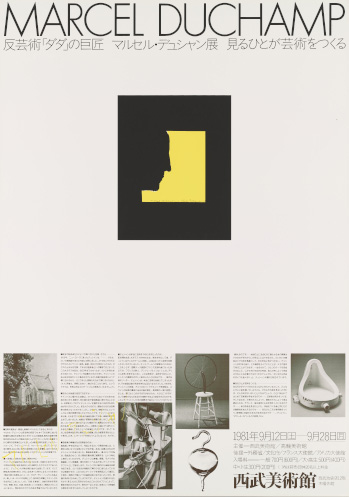
The Takanawa Museum was established in November 1962 on the grounds of the Shinagawa Prince Hotel in Minato City, Tokyo, to make publicly accessible the collection assembled by Yasujiro Tsutsumi, father of Seiji Tsutsumi. The collection included paintings, Buddhist sculptures, maki-e lacquerware, and East Asian ceramics.
In 1981, under the direction of Seiji Tsutsumi—also known by his literary pen name, Takashi Tsuji—the museum relocated from Takanawa to Karuizawa and reopened with the exhibition Marcel Duchamp. The museum shifted its focus to contemporary art, transforming itself from a traditional institution devoted to preserving and endorsing established cultural values into a site for experimental creativity and artistic production of its own time.
The decision to inaugurate the new museum with an exhibition devoted to Marcel Duchamp—regarded as a key point of origin for twentieth-century art—would have a lasting influence on the formation of the museum’s collection. For the opening, Duchamp’s widow and John Cage traveled to Japan. As a special program accompanying the exhibition, the event Music in Museum in Karuizawa was organized by Toshi Ichiyanagi and featured performances by John Cage, Aki Takahashi, Akiko Tatsumi, and Yasunori Yamaguchi, among others.
Two years after this exhibition, the Sezon Museum of Modern Art acquired Duchamp’s Boîte-en-valise (De ou par Marcel Duchamp ou Rrose Sélavy) (1935–1941/1968).
- Venue
-
The Museum of Modern Art, Seibu Takanawa
- Dates
-
August 1–September 6, 1981
- Organizer
-
The Museum of Modern Art, Seibu Takanawa; The Seibu Museum of Art
- Support
-
Ministry of Foreign Affairs of Japan, Agency for Cultural Affairs, Embassy of France in Japan, Embassy of the United States of America in Japan
- Touring Venue
-
The Seibu Museum of Art