






of Art, Tokyo
Abstract Expressionism
The Formative Years
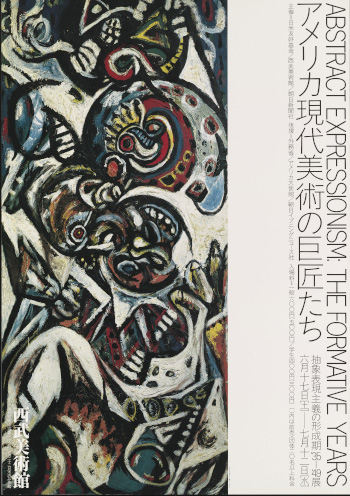
The emergence of Abstract Expressionism after World War II marked a major development in American art. Equally important, however, were the artistic developments of the 1930s and 1940s that laid the groundwork for its first generation. The activities and creative energy of artists who fled war-torn Europe and settled in the United States played a significant role in fostering the movement’s eventual flowering.
Focusing on key figures such as Jackson Pollock and Mark Rothko, both represented in the Sezon Museum of Modern Art collection, the exhibition traced the development of modern American art and explored the origins of Abstract Expressionism through works from the artists’ formative years in the 1930s and 1940s.
The exhibition also examined the activities of Surrealist artists such as Max Ernst, who relocated to New York from Europe during World War II, as well as the influence of Joan Miró’s automatism and Wassily Kandinsky’s geometric abstraction on Pollock, and the impact of Ernst’s primordial forms on Rothko. This lineage of abstract art, transmitted from Europe to the United States, closely resonates with both the exhibition program of the Seibu Museum of Art and the formation of the Sezon Museum of Modern Art collection.
- Venue
-
The Seibu Museum of Art
- Dates
-
June 17–July 12, 1978
- Organizer
-
The Japan–United States Friendship Commission, The Seibu Museum of Art, The Asahi Shimbun
- Touring Venue
-
Herbert F. Johnson Museum of Art Cornell University, Ithaca, New York; Whitney Museum of American Art, New York