






- Artist
-
Andy Warhol
- Date
-
1972
- Medium
-
Silkscreen on paper
- Dimensions
-
91.5×91.5cm(a set of ten works)
- Accession Number
-
WA-001-1~10
-
© 2026 The Andy Warhol Foundation for the Visual Arts, Inc. / Licensed by ARS,NY & JASPAR, Tokyo
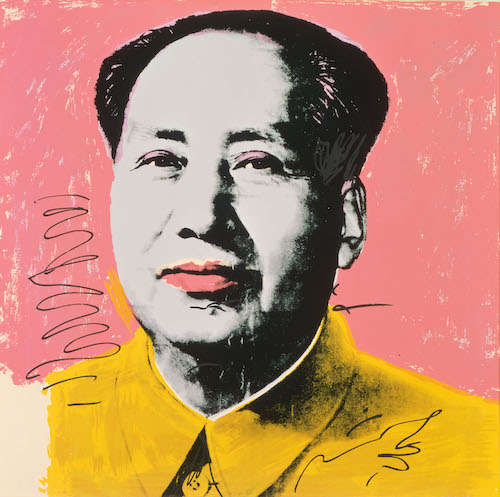
Beginning in the 1960s, Andy Warhol produced serial silkscreen portraits of celebrities, transforming some of the most recognizable figures of American capitalism into reproducible images. Portraits of individuals such as Marilyn Monroe and Elvis Presley—people who were, in reality, unique individuals—became mass-produced pop icons, endlessly reproduced and consumed through popular culture. The portrait thus shifted from a representation of a real person to a manufactured image.
Following the historic meeting between Richard Nixon and Mao Zedong in China, Warhol produced 199 silkscreen portraits of Mao between 1972 and 1973 in five different sizes. During the Cultural Revolution, portraits of Mao had been displayed throughout China as instruments of Communist propaganda, disseminating his image and ideology on a massive scale. In Warhol’s hands, even this authoritative image—an emblem of political power, personality cult, and propaganda—was transformed into a brightly colored, mass-produced pop icon through the medium of silkscreen.
By bringing together the visual strategies of political propaganda and capitalist marketing, this work blurs the boundary between the two systems. It suggests that both rely on the repeated circulation of powerful images and invites viewers to reconsider how authority, fame, and ideology are constructed through mass reproduction.
Andy Warhol
- Artist
-
Andy Warhol
- Date
-
1972
- Medium
-
Silkscreen on paper
- Dimensions
-
91.5×91.5cm(a set of ten works)
- Accession Number
-
WA-001-1~10
-
© 2026 The Andy Warhol Foundation for the Visual Arts, Inc. / Licensed by ARS,NY & JASPAR, Tokyo