






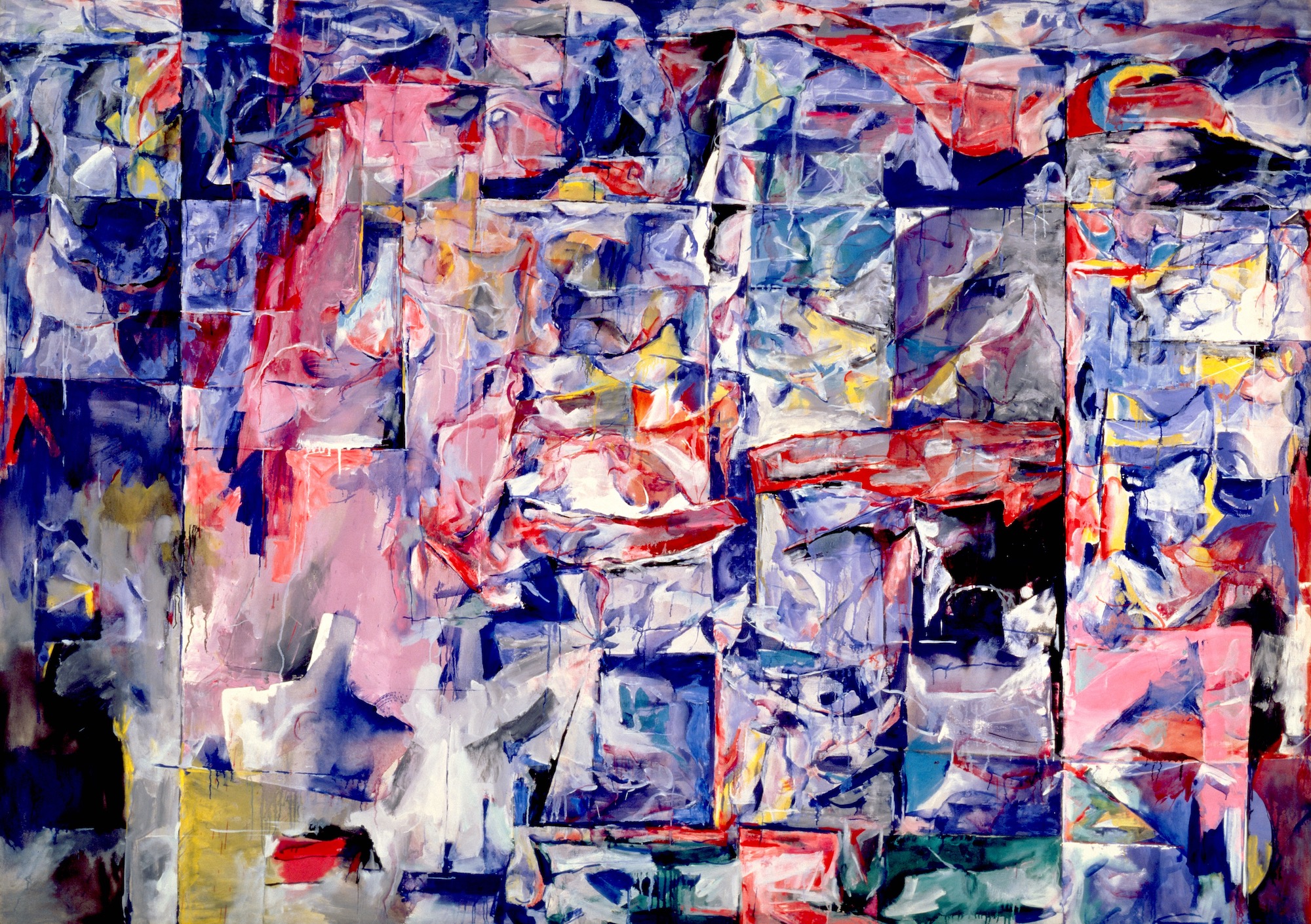
- Artist
-
Keiji Usami
- Date
-
1964
- Medium
-
Oil on canvas
- Dimentions
-
185.0×260.5cm
- Accession Number
-
UK-011
-
© Yaya Ikegami
Human silhouettes appear repeatedly throughout Keiji Usami’s work from around 1964 onward. Their prototype can be seen in works such as Dissolution-Body No.1 (1964), where faceless human forms were created by tracing the outline of the artist’s own body.
Usami developed these images by repeatedly placing paper cutouts of human figures onto the canvas, painting around them, and then removing them. Over time, these silhouettes came to evoke not only the artist’s own body, but also people moving through city streets, soldiers in the Vietnam War, and even the traces of bodies burned onto the walls of Hiroshima. Rather than depicting individual identities, these works address the human body as a social and historical presence. For this reason, the figures are necessarily without faces.
On the occasion of his first retrospective exhibition, Keiji Usami Retrospective: Reconstructing the World, held at the Sezon Museum of Modern Art in 1992, Usami reflected that many of his works before 1964 had been composed of finely nuanced white surfaces. Around the end of that year, however, he became increasingly conscious of his own physical presence within these increasingly homogenized pictorial spaces. Gradually, individual body parts such as arms and hips were transformed into full-body forms projected onto the canvas, giving rise to the human silhouette motif. For Usami, it was not the face but the body that became a vital means of representing the human condition.
Keiji Usami
- Artist
-
Keiji Usami
- Date
-
1964
- Medium
-
Oil on canvas
- Dimentions
-
185.0×260.5cm
- Accession Number
-
UK-011
-
© Yaya Ikegami