






- Artist
-
Man Ray
- Date
-
1916/1970
- Medium
-
Screenprint on acrylic glass
- Dimensions
-
52.0×37.0cm
- ed.
-
Edition of 40
- Accession Number
-
RM-002
Born in Philadelphia in 1890 to a family of Russian-Jewish immigrants, Emmanuel Radnitzky moved to New York with his family at an early age. In 1912, as his family changed their surname from Radnitzky to Ray in response to anti-Semitic prejudice, he adopted the name “Man,” derived from Emmanuel, and began calling himself “Man Ray,” a name not tied to any specific nationality or cultural background. Two Figures (1914), in the museum’s collection, already bears the signature “Man Ray.” The name itself is a play on words: in English, it can be read as “a man of light” (ray), while in French it echoes the pronunciation of main, meaning “hand.”
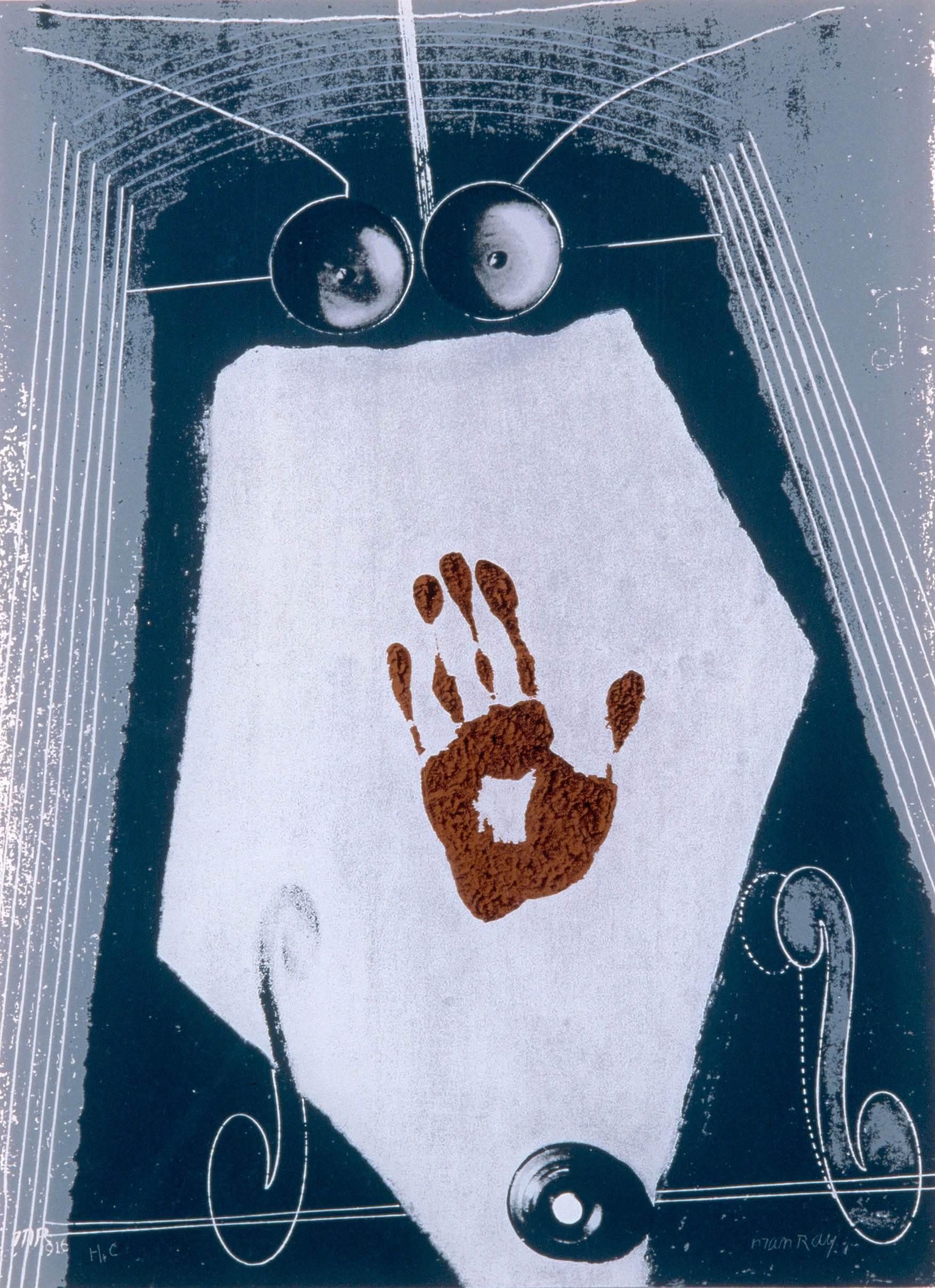
Self-Portrait, first exhibited in Man Ray’s solo exhibition at the Daniel Gallery in New York in 1916, was an assemblage. The original work was subsequently lost, and for many years was known only through photographs. It was reconstructed in 1963, and a silkscreen version was produced in 1970. Beneath two ready-made bells resembling eyes are push buttons that appear capable of ringing them, yet the bells produce no sound. At the center, a red oil-painted imprint of Man Ray’s hand (main) serves as a signature. The painted f-holes further suggest a musical instrument, but one that can neither ring nor make music. This early work transforms Man Ray himself into an object, combining visual puns and linguistic play characteristic of his artistic practice.
Man Ray
- Artist
-
Man Ray
- Date
-
1916/1970
- Medium
-
Screenprint on acrylic glass
- Dimensions
-
52.0×37.0cm
- ed.
-
Edition of 40
- Accession Number
-
RM-002