






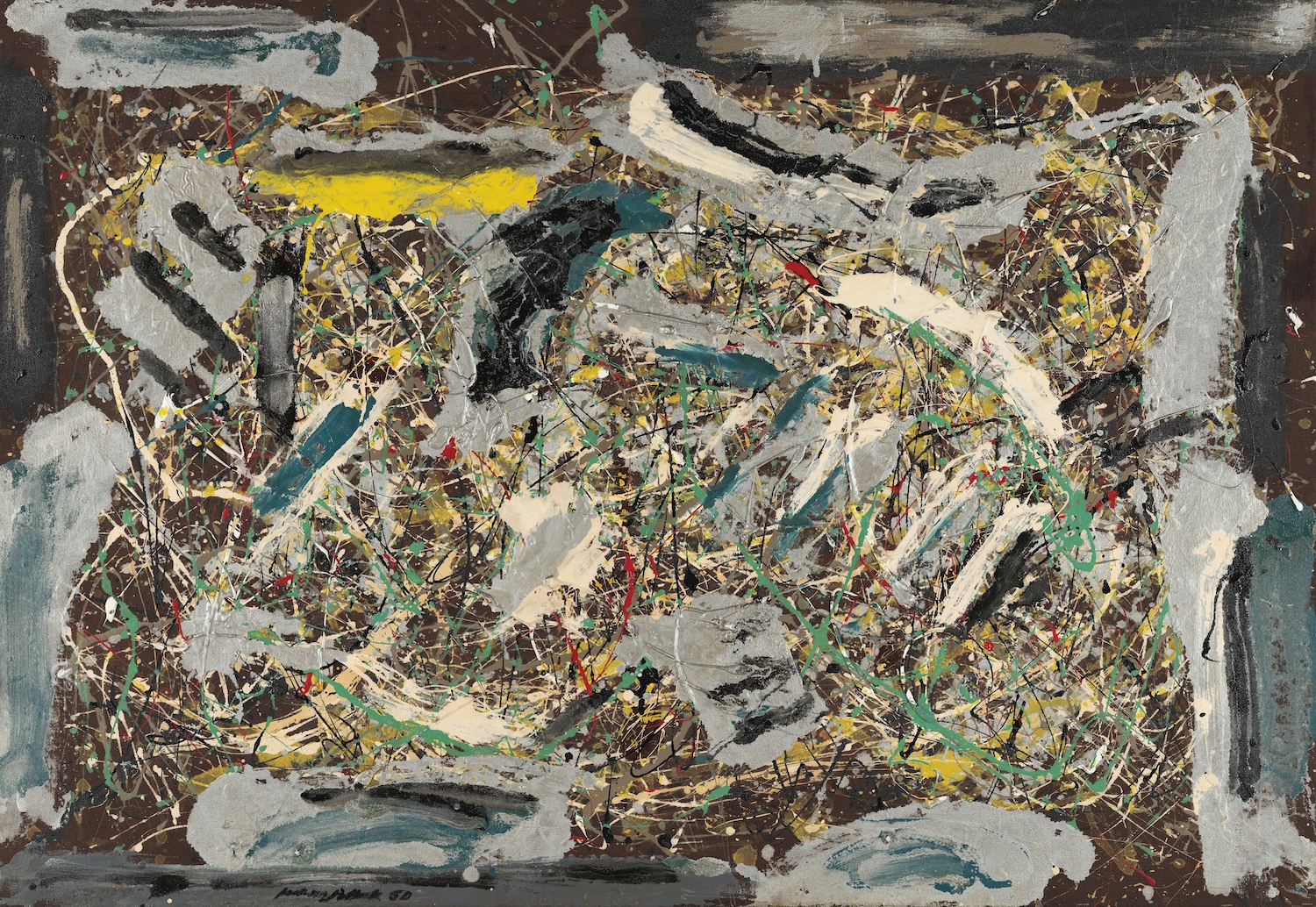
- Artist
-
Jackson Pollock
- Date
-
1950
- Medium
-
Enamel and encaustic on cotton duck
- Dimention
-
91.4×132.0cm
- Accession Number
-
PJ-001
Beginning in the 1930s, the Federal Art Project—part of the United States’ New Deal initiatives—commissioned artists to create posters, paintings, sculptures, and murals that enriched public spaces. Jackson Pollock was among the artists supported by this program. The project drew inspiration in part from Mexico’s earlier cultural reforms, in which the government hired artists to paint large-scale murals depicting the history and ideals of the Mexican Revolution on the walls of schools and public buildings. These monumental murals had a profound influence on American artists.In particular, the murals and paintings of David Alfaro Siqueiros significantly impacted Pollock. Siqueiros employed what he called “controlled accident,” a technique in which paint or industrial lacquer was poured directly from the can onto a horizontally placed panel. This approach later informed Pollock’s own method of dripping paint from cans—often pierced at the bottom—onto canvases laid flat on the floor.
In this work, the rapid-drying qualities of wax and enamel allow Pollock to build layers of improvisational drips, stains, and vigorous brushwork. These elements spread across the entire surface like a mural, enveloping the viewer in dynamic motion. During the postwar expansion of American power, Pollock developed a mode of painting distinct from the European tradition of easel painting meant for interior contemplation. By 1950, the year this work was created, he represented the United States at the Venice Biennale.Through the rise of Abstract Expressionism—epitomized by Pollock—the center of the art world shifted from Paris in Europe to New York in the United States.
Jackson Pollock
- Artist
-
Jackson Pollock
- Date
-
1950
- Medium
-
Enamel and encaustic on cotton duck
- Dimention
-
91.4×132.0cm
- Accession Number
-
PJ-001