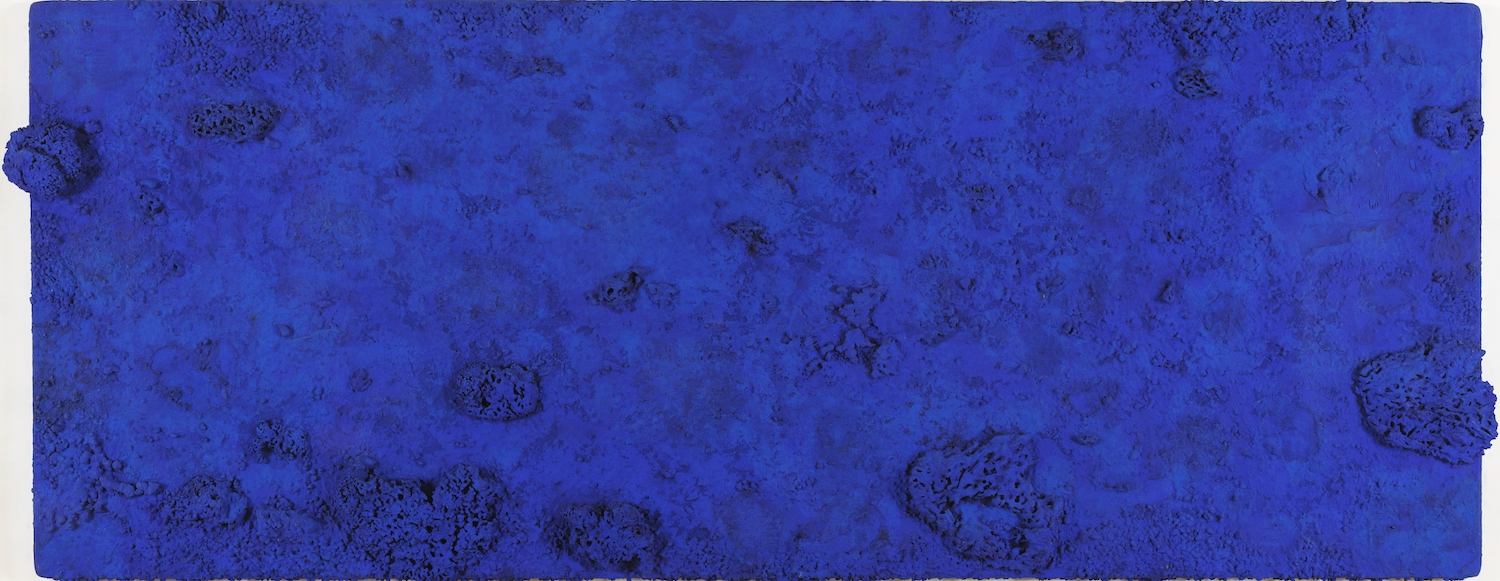
Yves Klein’s work—including his monochrome paintings, sponge reliefs, and Anthropometry series—unfolds a world immersed in the color blue, expressed through IKB (International Klein Blue), the pigment he named and developed. Disliking traditional oil paint, Klein felt a vital energy in pure powdered pigment and believed it opened the way to new freedoms in painting. While producing his monochromes in the studio, he noticed the beauty of blue pigment seeping into his working sponges, which he later adopted as materials for his art. This notion of “impregnation”—in which viewers, like the wild sponges that absorb all liquid, become saturated by blue while moving around the monochromes—became fundamental to Klein’s practice.
In 1958, Klein held a groundbreaking exhibition at the Iris Clert Gallery in Paris titled La spécialisation de la sensibilité à l’état matière première en sensibilité picturale stabilisée, “Le Vide” (“The Specialization of Sensibility in the Raw Material State into Stabilized Pictorial Sensibility, ‘The Void’”). The gallery’s exterior windows were painted blue, and a pedestal draped in blue cloth was placed at the entrance. By contrast, the interior was painted entirely white and left completely empty. Visitors were served a special cocktail of gin, Cointreau, and methylene blue. With blue visible only on the outside of the building and white filling the interior, the blue pigment permeated the bodies of viewers through the cocktail, creating a dematerialized blue space that existed physically within them rather than on the gallery walls.