






- Artist
-
Anselm Kiefer
- Date
-
1992
- Medium
-
Mixed media,(14 steel beds, lead, etc)
- Dimensions
-
Exhibition area 890×1,235
- Accession Number
-
KA-003
-
© Anselm Kiefer
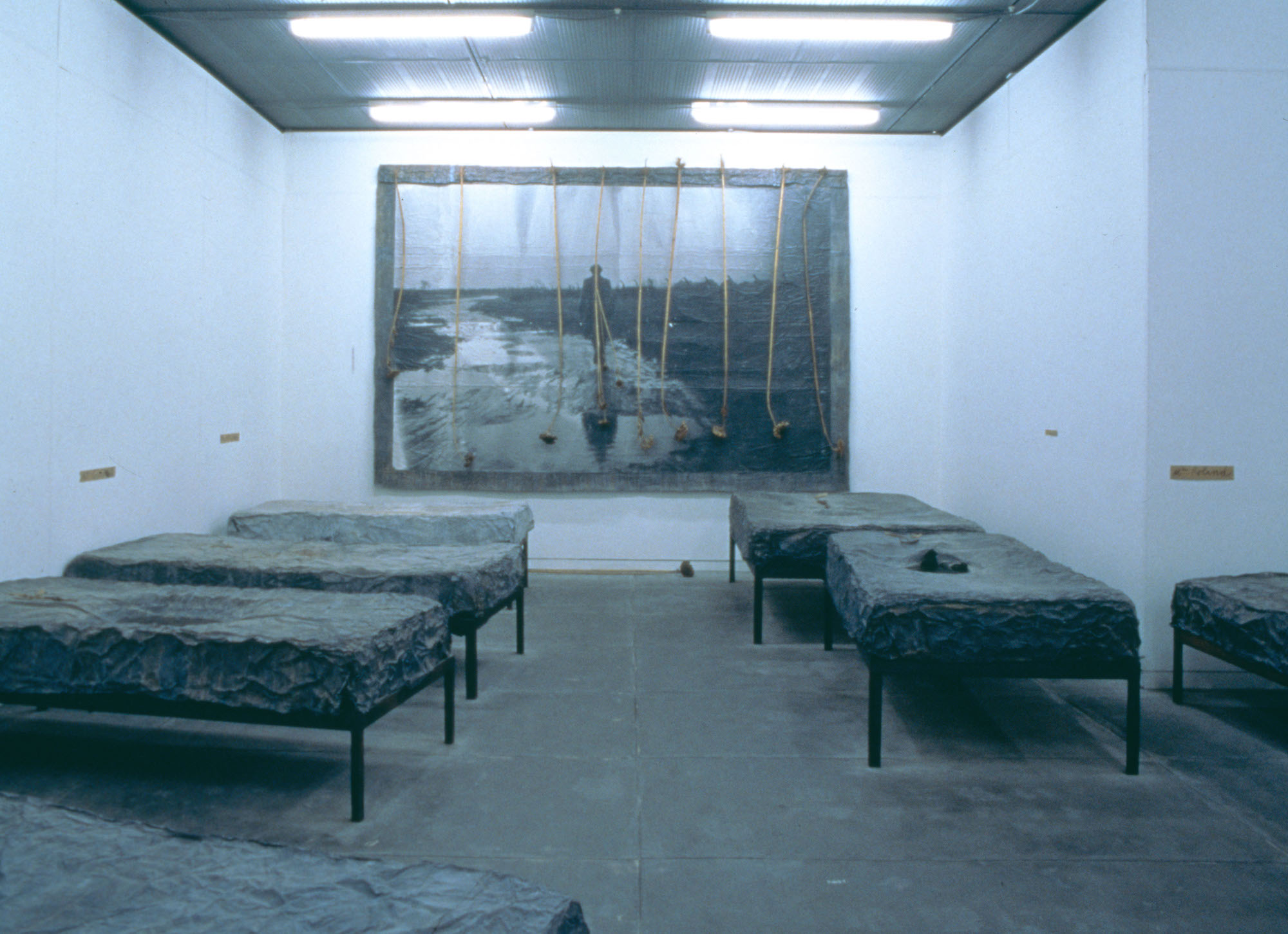
In Women of the Revolution (1854), the nineteenth-century French historian Jules Michelet portrayed the lives of women who experienced the French Revolution. A century later, the French critic and philosopher Roland Barthes published Michelet (1954), a study that examined not only Michelet himself but also the ways in which history is constructed through narrative. Drawing upon this layering of history and its interpretation, Anselm Kiefer created Women of the Revolution. For Kiefer, history is not merely a collection of facts, but a story that continually changes according to who tells it.
An earlier work bearing the same title was produced in 1986. In that installation, dried flowers were placed within lead frames inscribed with the names of women from the French Revolution. In the present work, those frames have been transformed into fourteen lead beds. Water fills a hollow at the center of each bed, where dried flowers float, while the names of twenty-one women from the revolutionary period, including Marie Antoinette, are displayed on the wall. These faceless beds suggest both the absence of the individuals they commemorate and the many women whose lives have been forgotten or only rarely acknowledged in historical narratives.
Lead, a material frequently used by Kiefer, has long been associated in alchemy with a primordial substance capable of transformation into silver or gold. Though it appears heavy and solid, it is remarkably soft and easily deformed. In this sense, lead can be seen as analogous to the human body, which continually changes through the cycle of life and death. The dried sunflowers, another recurring motif in Kiefer’s work, function as symbols of human existence, evoking themes of mortality, regeneration, and the cyclical nature of life.
Kiefer once remarked that “the French share the memory of a great revolution, whereas the Germans never arrived at revolution.” The photographs positioned beyond the beds suggest a passage of time extending from the French Revolution to the present day. Together with the dried sunflowers, they appear to connect past and present, the living and the dead. Rather than simply revisiting historical events, Kiefer’s installation invites reflection on the stories that surround human lives, the collective memory of revolution, and the ways in which we inherit, interpret, and retell history ourselves.
Anselm Kiefer
- Artist
-
Anselm Kiefer
- Date
-
1992
- Medium
-
Mixed media,(14 steel beds, lead, etc)
- Dimensions
-
Exhibition area 890×1,235
- Accession Number
-
KA-003
-
© Anselm Kiefer