






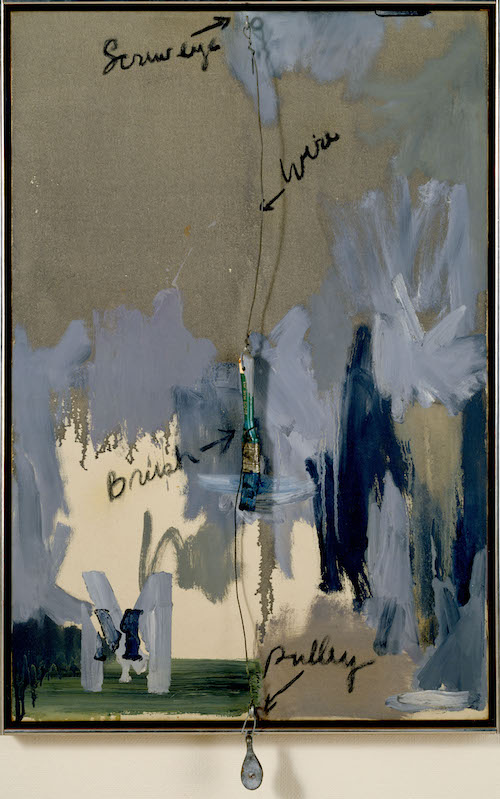
- Artist
-
Jasper Johns
- Date
-
1962
- Medium
-
Oil on canvas with obujects
- Dimensions
-
91.4×71.0cm
- Accession Number
-
JJ-002
-
© 2026 Jasper Johns / ARS, New York / JASPAR, Tokyo E6362
By around 1960, Jasper Johns had already begun incorporating various studio tools into his works, including brushes, cans, measuring instruments, stretchers, and wire. However, it was not until around 1962 that he started combining these elements in ways that explicitly evoked the studio as a site of artistic production and the act of painting itself. Works such as Fool’s House (1961–62) and Studio (1964) exemplify this development.
In Fool’s House, a broom hanging from the canvas functions as a paintbrush, while a cup attached to the right side serves as a palette. Everyday objects and artistic tools are treated as equivalents, each identified by a written name accompanied by an arrow. Around this time, Johns began labeling the objects he depicted, prompting viewers to reflect on the relationship between objects and their names, vision and language, and the ways meaning is generated through those associations.
In the present work, the broom has been transformed more explicitly into a paintbrush. The brush, inscribed with the words “Blue Jay” on its handle, appears to apply blue paint directly onto the canvas. Suspended between two wires attached to screws at the top and bottom of the support, the brush hangs above a metal pulley fixed at the lower edge. Here again, the objects are identified through words and arrows, reinforcing the connection between language and things.
On the left side of the composition, two letter “M”s can also be seen. These have been interpreted as references either to René Magritte, who famously explored the relationship between language and representation, or to Marcel Duchamp.
Whereas Duchamp challenged traditional aesthetic values and artistic institutions by introducing everyday manufactured objects into the realm of art, Johns continued to work within the medium of painting while linking its surface to familiar images and actual objects. By employing ordinary tools from his immediate surroundings and assigning them names, he drew attention to the everyday nature of artistic production itself. In doing so, Johns explored the materiality of painting, the relationship between language and image, and the shifting boundary between art and everyday life.
Jasper Johns
- Artist
-
Jasper Johns
- Date
-
1962
- Medium
-
Oil on canvas with obujects
- Dimensions
-
91.4×71.0cm
- Accession Number
-
JJ-002
-
© 2026 Jasper Johns / ARS, New York / JASPAR, Tokyo E6362