






- Artist
-
Marcel Duchamp
- Date
-
1935-1941/1968
- Medium
-
80 reproductions in linen covered bod
- Dimentions
-
10.2×40.7×38.1cm
- Accession Number
-
DM-001
-
©Association MarcelDuchamp/ADAGP, Paris & JASPAR, Tokyo, 2026, E6362
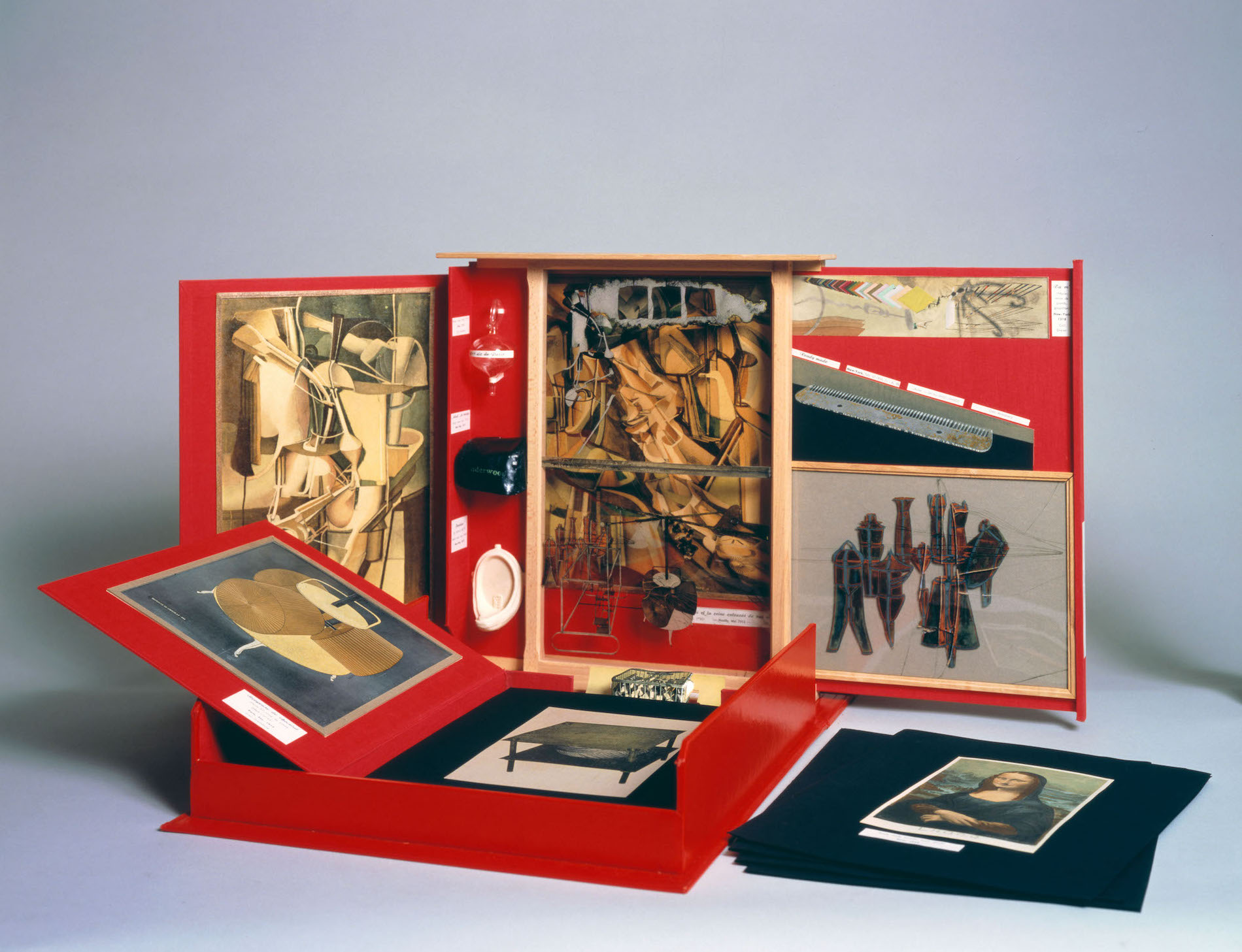
Marcel Duchamp spent approximately five years, beginning in 1935, photographing and reproducing his own works, ultimately producing around 300 boxed sets. At a time when photography, printing technologies, and mechanical mass production were rapidly advancing, Duchamp deliberately chose the labor-intensive and technically sophisticated collotype printing process, enhanced with hand-applied stencil coloring. Through this undertaking, he created a space in which the distinctions between unique works of art and mass-produced objects, manual originality and mechanical reproducibility, authenticity and imitation became increasingly ambiguous.
Duchamp entrusted much of the manual production process to specialized workshops, while he himself focused on selecting colors and materials and directing the overall project. In doing so, he challenged the conventional notion that an artist’s own handiwork is essential to the definition of art. This “portable museum” can thus be understood as the culmination of Duchamp’s creative practice, achieving both a reinterpretation of his earlier works and the generation of new artistic value.
In 1941, a deluxe edition limited to twenty sets was produced. In addition to sixty-nine reproductions, each set included an original work attached to the inside of the lid. These editions were housed in leather and velvet cases fitted with handles and metal hardware.
The museum’s Boîte-en-valise belongs to the standard edition series of approximately 300 examples. Its exterior is covered in deep crimson leather, while the interior is lined with red linen; unlike the deluxe editions, it lacks handles and metal fittings. Earlier standard versions contained sixty-eight reproductions, but Duchamp later revised the contents by adding twelve more works, bringing the total to eighty reproductions.
Inside the box, alongside a wooden framework in the shape of the letter “M,” a gray card bears the inscription: “de ou par Marcel Duchamp ou Rrose Sélavy” (“by or from Marcel Duchamp or Rrose Sélavy”). Rrose Sélavy was Duchamp’s female alter ego, a second identity through which he embodied both masculine and feminine personas. The name itself is a pun on the French phrase “Eros, c’est la vie” (“Eros, that is life”). It has also been suggested that the word valise in Boîte-en-valise participates in a similar linguistic play with “Sélavy.” As such, this work may be understood not only as a “box in a suitcase,” but as a box containing Duchamp’s life itself.
Marcel Duchamp
- Artist
-
Marcel Duchamp
- Date
-
1935-1941/1968
- Medium
-
80 reproductions in linen covered bod
- Dimentions
-
10.2×40.7×38.1cm
- Accession Number
-
DM-001
-
©Association MarcelDuchamp/ADAGP, Paris & JASPAR, Tokyo, 2026, E6362