






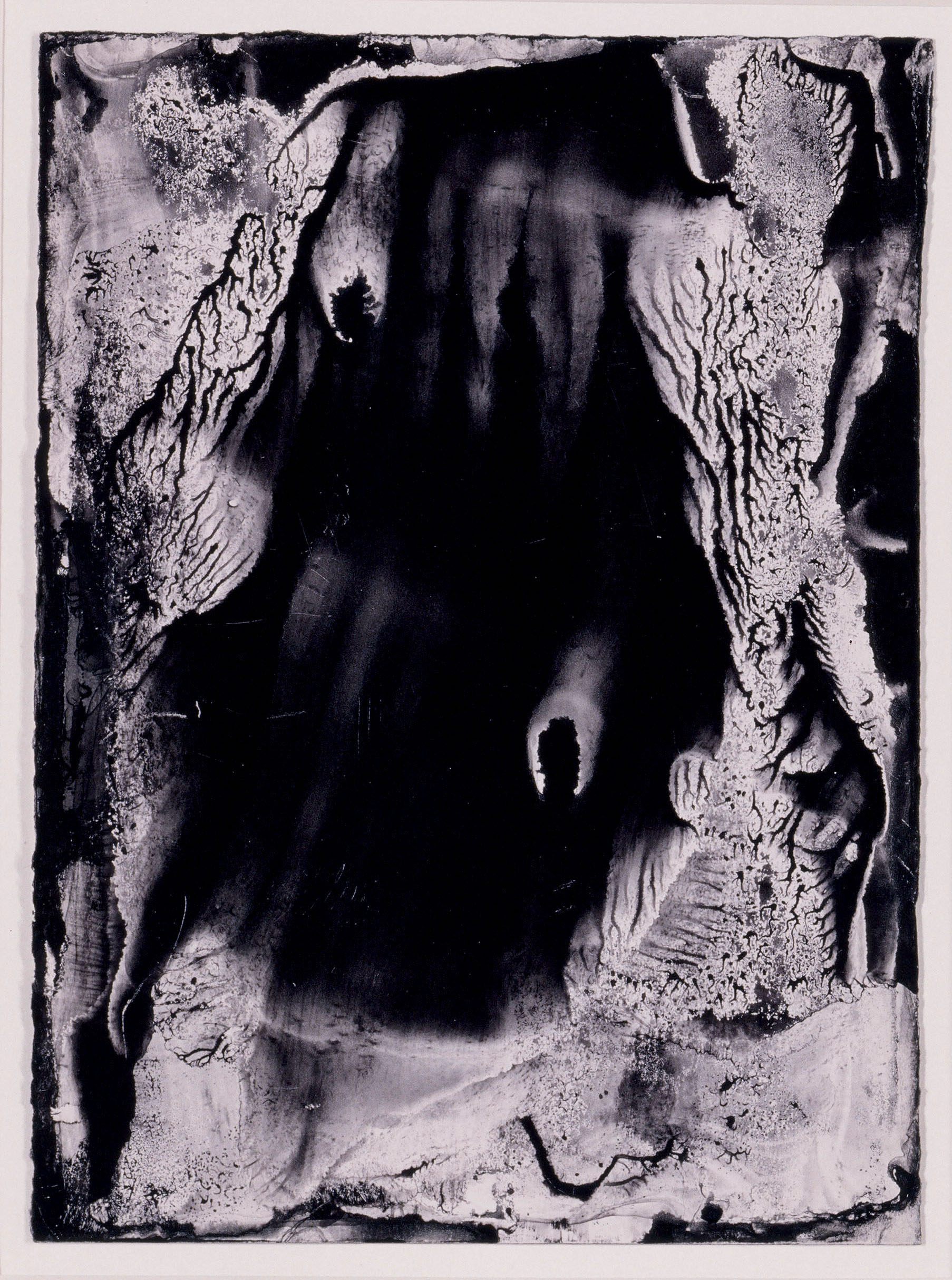
- Artist
-
Shuzo Takiguchi
- Date
-
1962
- Medium
-
Decalcomania
- Dimentions
-
13.8×9.3cm
- Accession Number
-
TS-010
-
© Mayumi Kawamura
Decalcomania is a technique in which paint is pressed between sheets of paper and then separated, producing accidental stains and patterns. Surrealist artists employed it as a means of “automatic writing” to express the unconscious, and in the 1930s it was explored by artists such as Oscar Domínguez and Max Ernst. Shuzo Takiguchi also produced decalcomania works in 1937, and one of his own works was used for the cover of the special issue Overseas Surrealist Works of Mizue.
Around 1959, Takiguchi began to feel constrained by journalistic criticism and turned instead to non-verbal line drawings, sketches, and watercolors. In 1962, he became absorbed in decalcomania, a technique he described as a “poetic experiment.” For Takiguchi, these works represented an exploration of processes of emergence and transformation through direct engagement with materials, allowing forms to arise from the encounter between paper and paint. The Museum’s seven black-and-white decalcomanias were all produced between 1962 and 1964.
During this same period, Takiguchi was writing “Klee Is Here,” an essay for the commemorative publication of the Paul Klee Exhibition. In it, he wrote that “a painting, like a living organism, possesses its own principle of generation.” His decalcomanias may likewise be understood not simply as images that were made, but as works that emerged through a process of formation shaped by chance. Takiguchi also maintained close relationships with Marcel Duchamp, Shusaku Arakawa, and Mitsuo Kano, making him an important figure in understanding the Museum’s collection.
Shuzo Takiguchi
- Artist
-
Shuzo Takiguchi
- Date
-
1962
- Medium
-
Decalcomania
- Dimentions
-
13.8×9.3cm
- Accession Number
-
TS-010
-
© Mayumi Kawamura