






- Artist
-
Man Ray
- Date
-
1939/1946
- Medium
-
Banjo, convex lens and strings
- Dimensions
-
71.0×24.5×18.0cm
- Edition
-
E.A.
- Accession Number
-
RM-017
-
©MAN RAY 2015 TRUST / ADAGP, Paris & JASPAR, Tokyo, 2026 E6362
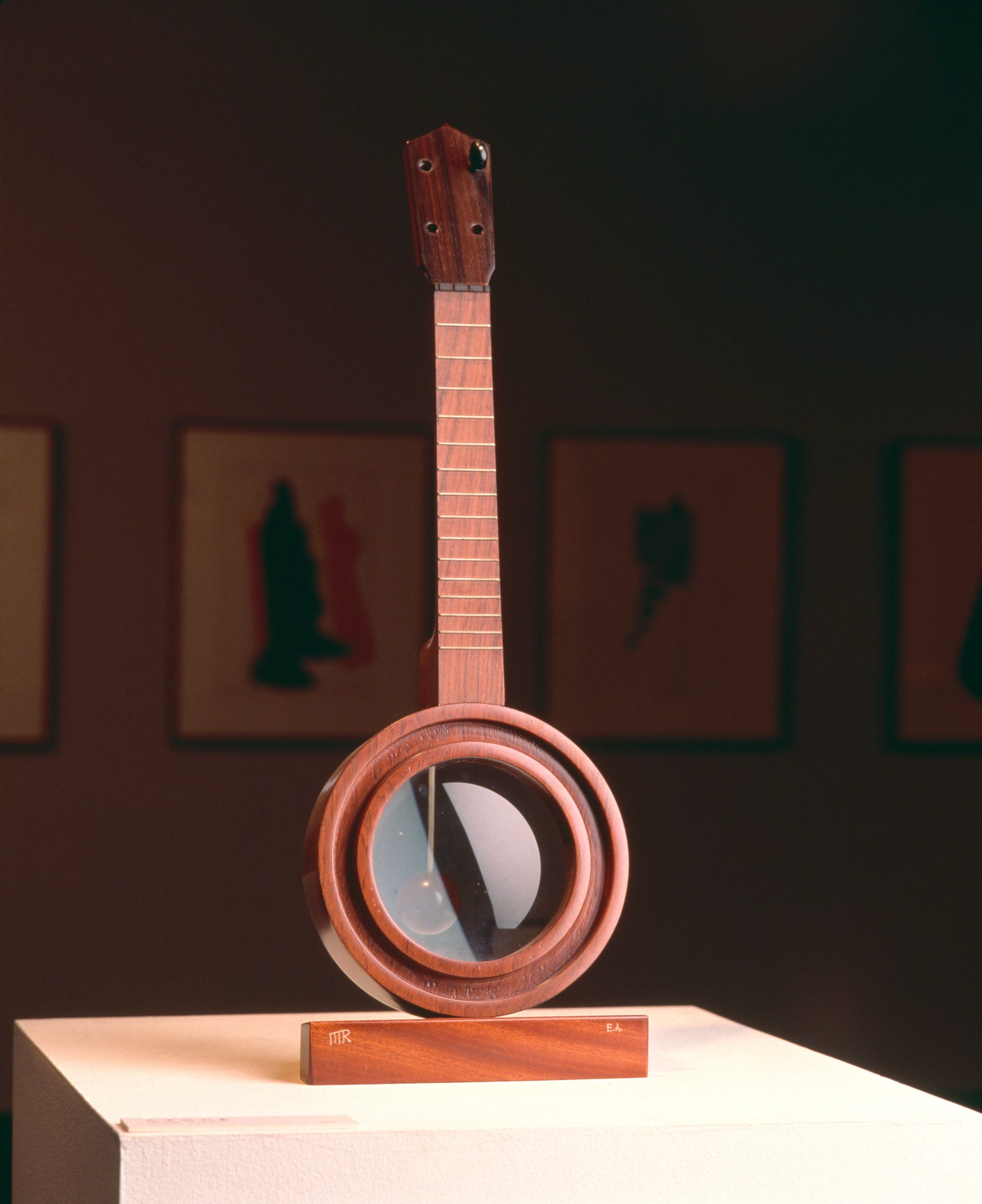
Musical instruments appear repeatedly in Man Ray’s work, most famously in Le Violon d’Ingres (1924), which draws an analogy between the human body and a violin. This work likewise employs a musical instrument as its basis, using a banjo as an object. In place of the strings and drumhead normally found at its center, a magnifying lens has been inserted, through which a ball suspended by a string can be seen.
Because the lens is convex, the small object beyond it appears larger than it actually is. Yet when viewed from behind, the ball is revealed to be of ordinary size, creating a discrepancy between expectation and reality. The viewer may even experience a sense of disappointment when confronted with the difference between the optical effect and the object itself.
The word “illusions” in the original title, Optical Hopes and Illusions, refers not only to visual deception but also to the transformative power of art. By altering familiar objects and situations, Man Ray destabilizes the boundary between reality and fiction, inviting viewers to question the reliability of what they see.
Man Ray
- Artist
-
Man Ray
- Date
-
1939/1946
- Medium
-
Banjo, convex lens and strings
- Dimensions
-
71.0×24.5×18.0cm
- Edition
-
E.A.
- Accession Number
-
RM-017
-
©MAN RAY 2015 TRUST / ADAGP, Paris & JASPAR, Tokyo, 2026 E6362