






- Artist
-
Natsuyuki Nakanishi
- Date
-
1969
- Medium
-
Oil on canvas
- Dimentions
-
73.1×91.5cm
- Accession Number
-
NN-001
-
©︎ NATSUYUKI NAKANISHI
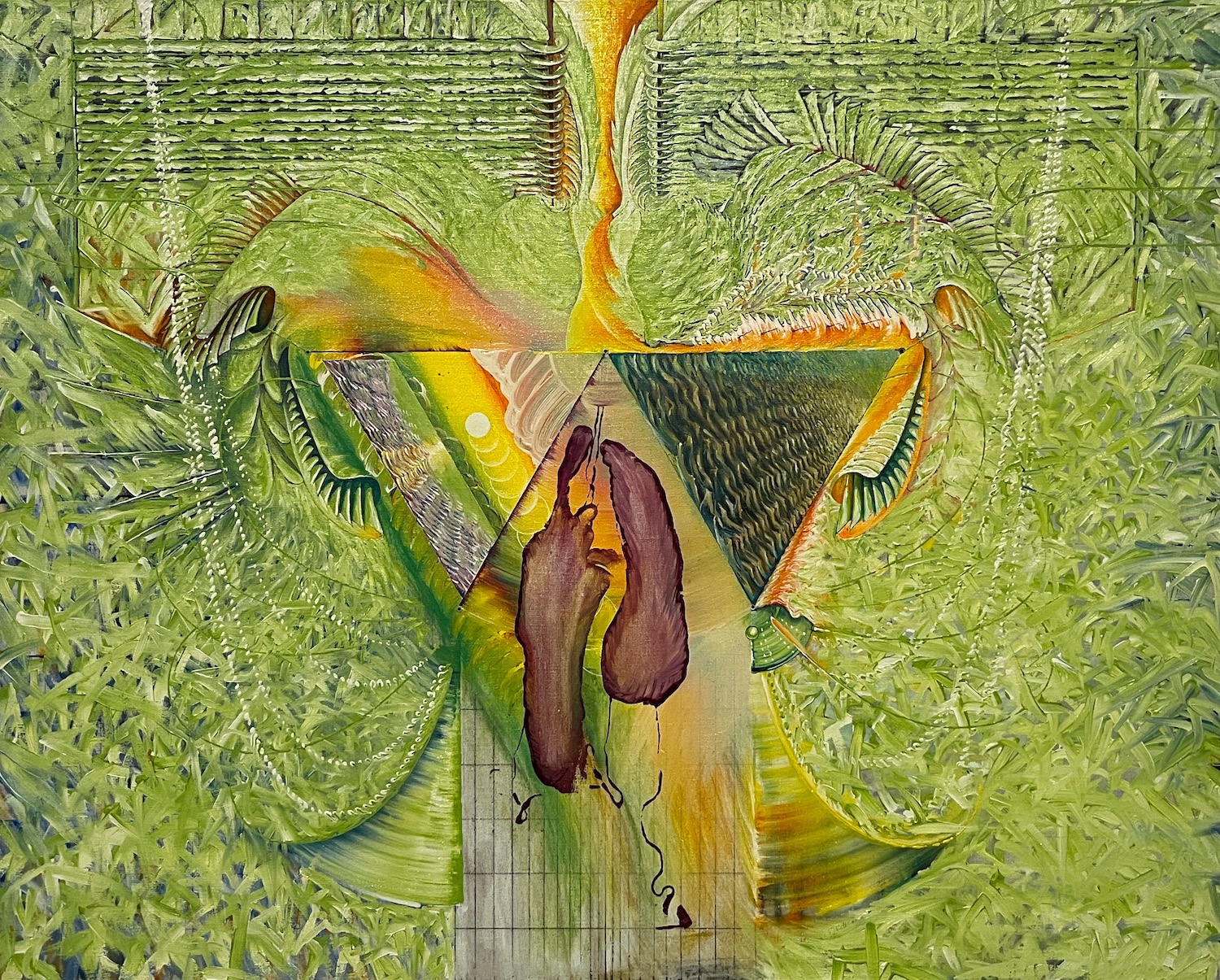
Hopscotch at the Summit is a series of eleven oil paintings produced between 1969 and 1972, numbered No.0 through No.10. The museum holds No.2, No.3, No.4, and No.10. The title does not refer to a specific image; rather, it points to the place where painting comes into being and to the bodily act of painting itself.
The series is rooted in How to Draw a Heart Supported by Two Equilateral Triangles (1966), a work inspired by a diagram illustrating the construction of a heart shape in the 1935 edition of the Larousse Encyclopedia under the entry “Coeur” (Heart). The two equilateral triangles and inverted triangle that appear in these paintings derive from this method of construction. For Nakanishi, however, such geometric structures were not merely formal devices but were closely connected to bodily movement. The footprint at the center of the composition evokes the sensation of standing on a mountain summit where only a small flat surface remains, creating the feeling that the soles of one’s feet are almost suspended above the ground. This sensation is linked to the bodily rhythm of a stone-kicking game, in which the body repeatedly opens and closes in motion.
Yet for Nakanishi, the focus was not solely on the body of the person kicking the stone. Once launched from the summit, the stone traces an imagined trajectory that connects distant mountains and mountain ranges beyond. Its movement links a nearby point to a faraway place, reflecting Nakanishi’s ongoing interest in the relationships between the body, distance, and indirect action.
In 1986, the solo exhibition Hopscotch at the Summit was held at The Contemporary Art Gallery on the sixth floor of Seibu Department Store in Ikebukuro. In “Along the Magnetic Field,” an essay contributed by Takashi Tsujii to the catalogue of the Natsuyuki Nakanishi Exhibition (1989) at the Seibu Museum of Art and The Museum of Modern Art, Seibu Takanawa, Tsujii argued that Nakanishi’s paintings are concerned not with the depicted object itself, but with the relationship between the object and the person who paints it. For Nakanishi, painting was not a means of representing the world as it appears, but an attempt to make visible on a flat surface the relationships that emerge between body and space, proximity and distance, contact and separation.
Natsuyuki Nakanishi
- Artist
-
Natsuyuki Nakanishi
- Date
-
1969
- Medium
-
Oil on canvas
- Dimentions
-
73.1×91.5cm
- Accession Number
-
NN-001
-
©︎ NATSUYUKI NAKANISHI